
Forever Wars
Inside our Spring 2026 issue, with writing on Iran, Ukraine, Vietnam, America at 250, and more

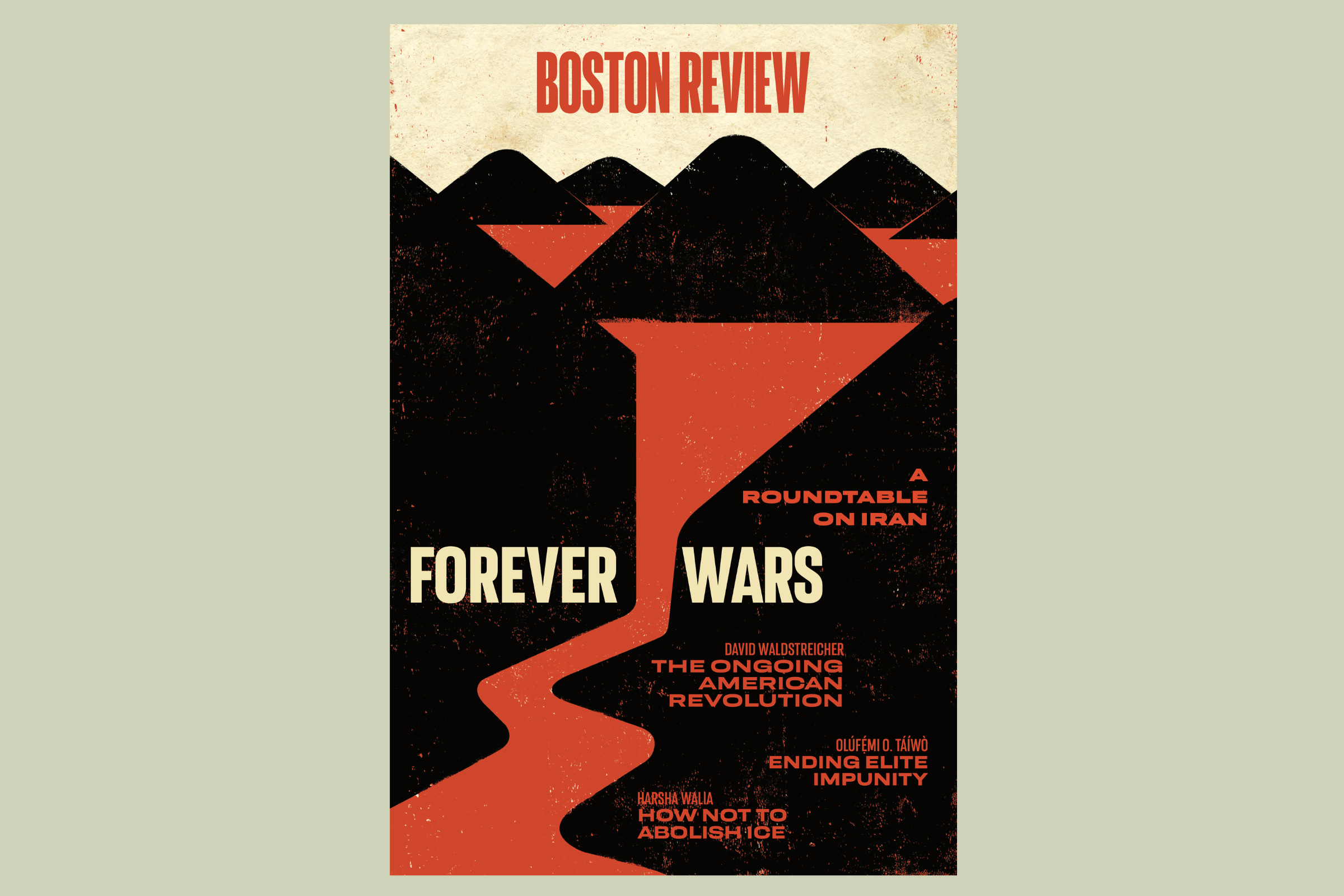
Our new issue, FOREVER WARS, heads to press soon. Here’s a preview of what’s inside.
A roundtable on the U.S.-Israeli war on Iran, with Peyman Jafari, Ali Kadivar, Manijeh Moradian, Naghmeh Sohrabi, and Alex Shams:
We have seen different rationales given for this war exactly because making the real reason explicit would have been unhinged, even for Netanyahu and Trump. At the end of the day, from the Israeli perspective, it is really about eliminating any obstacle to its long-term project, which is the subjugation of the Palestinians. As for the United States, Israel has always been an outpost of American empire in the Middle East; the war is therefore also about resurrecting, or entrenching, American empire. We Iranians tend to think it is all about us, but I think it has to do with the imperial anxieties of the American elite.
The messaging has thus been aimed not only at Iran—we will crush you, we will use enormous amounts of violence, we will send you back to the Stone Age—but also at Europeans, at U.S. allies: you will be disciplined. The United States is making clear that this is the imperial hierarchy: the United States on top and then the Europeans. The war is also a signal to Russia and China that the United States is still the biggest military power. If its economic position has declined, the United States can compensate through sheer military might.
Olúfẹ́mi O. Táíwò on why elites should be worried:
The present administration has dismantled climate rules and subsidies, eliminated vaccine recommendations for children while cutting funding for food safety inspections; and slashed the budget of the office that collects tax revenue while claiming its other layoffs were motivated by a concern over government debt. And it has done all of this while initiating a war in the most politically volatile region of the world and on the flimsiest of pretexts. They sustain this carelessness by holding onto a raft of genuine insight amid the sea of delusion: they have, up until now, been extraordinarily successful in making other people pay the price for their mistakes and crimes. But that raft is thin. The structure whose supports they are steadily kicking away is also the one that props up their own personal safety from disaster and political invulnerability to accountability. And all of this can go away.
David Waldstreicher on America at 250:
Two hundred and fifty years after the Declaration of Independence was signed by some three dozen men in Philadelphia, new forms of Frederick Douglass’s old question—“What, to the American slave, is your Fourth of July?”—cry out for an answer. How should we remember the American Revolution when millions march in the streets and shout “No Kings!”? When squads of masked thugs invade homes without warrant and kangaroo immigration “courts” deport hundreds of thousands without due process? When agents of the state shoot and kill protesters but don’t come to trial, unlike the British soldiers who fired on demonstrators during the Boston Massacre? When a Congress-spurning president, more callow and depraved than George III appeared in any propaganda of 1776, commands the largest military in the world to drop bombs in furtherance of a rapacious empire, as the Patriots said the British had become?
Harsha Walia on how not to abolish ICE:
The terror of ICE home invasions, racially motivated man hunts by law enforcement, car chases at traffic stops, chemical warfare, and abandoned children in abandoned cars shake our collective psyche—not only because of the naked brutality, but because they expose how the border can follow migrants anywhere; there is no refuge from it. The infrastructure and ecosystem of entire towns are being reshaped by this moving border: ordering people, disappearing immigrants, paramilitarizing neighborhoods, and turning cities into the borderlands. The border reveals itself as an elastic regime that is at once domestic and global, internalized and externalized.
Farah Bakaari on Somaliland’s empty victory:
On December 26, I awoke to learn of the news that Israel had become the first country in the world to officially recognize Somaliland as a sovereign state, its triumphant announcement capped off with a congratulatory FaceTime call between Benjamin Netanyahu and Somaliland’s president, Abdirahman Mohamed Abdullahi. With that, the first country to recognize Somaliland was not one of the postcolonial nations whose independence struggles Somalilanders had claimed as their own but an occupying genocidal state that has worked tirelessly to ensure the failure of another people’s claims to self-determination.
Also inside:
A war diary from Tehran, plus dispatches from Beirut, Baghdad, and Ramallah
A photo essay by J. Lester Feder on the queer face of war in Ukraine
Andrew Holter revisits Mary McCarthy’s Vietnam reporting in a new era of wartime illusions
Reviews of Helen DeWitt & Ilya Gridneff’s Your Name Here, Kelly Reichardt’s The Mastermind, and recent books on disability and the good life
Was the USA created to fight wars? We're told no, but it seems so.