
Truth Without Reconciliation
Olúfẹ́mi O. Táíwò on what the United States must learn from Brazil

This essay is featured in our Summer 2026 issue. Subscribe to get a copy.
On January 5, 2025, then president Joe Biden addressed reporters and reaffirmed his commitment to a peaceful transfer of power amid the wait for election results, nearly four years to the day after the infamous attempted coup of January 6. “I think what [Trump] did was a genuine threat to democracy,” Biden said, “and I’m hopeful that we’re beyond it.” We were not. Days later, in his inaugural address, Trump made false claims of election fraud, just as he had done in 2020.
The United States is several years into a disastrous surge in right-wing authoritarianism. Just days ago, ICE murdered a father in front of his three-year-old daughter in Maine and left his posthumously handcuffed body in the street for five hours. The latest mass deportation surge only adds another layer to the structural reality of constant, unaccountable police violence: according to Campaign Zero, there were only six calendar days in the entirety of 2025 in which law enforcement did not kill someone.
One looks abroad with equal parts curiosity and envy at other countries that have managed to fend off their own right-wing insurgencies, including South Korea, where the former president narrowly escaped a death sentence for his role in instigating an attempted coup thwarted only by a brave mass protest, and Hungary, where Viktor Orbán’s recent electoral defeat cemented a setback for the international right-wing coalition that had rallied to his defense. These are worth learning from for a host of reasons, perhaps chief among which is that a network of actors are working in concert across these different national boundaries to support right-wing governments by fomenting xenophobic panic and violence. But among the examples from abroad that thinkers here should pay attention to, one stands out in particular: Brazil.
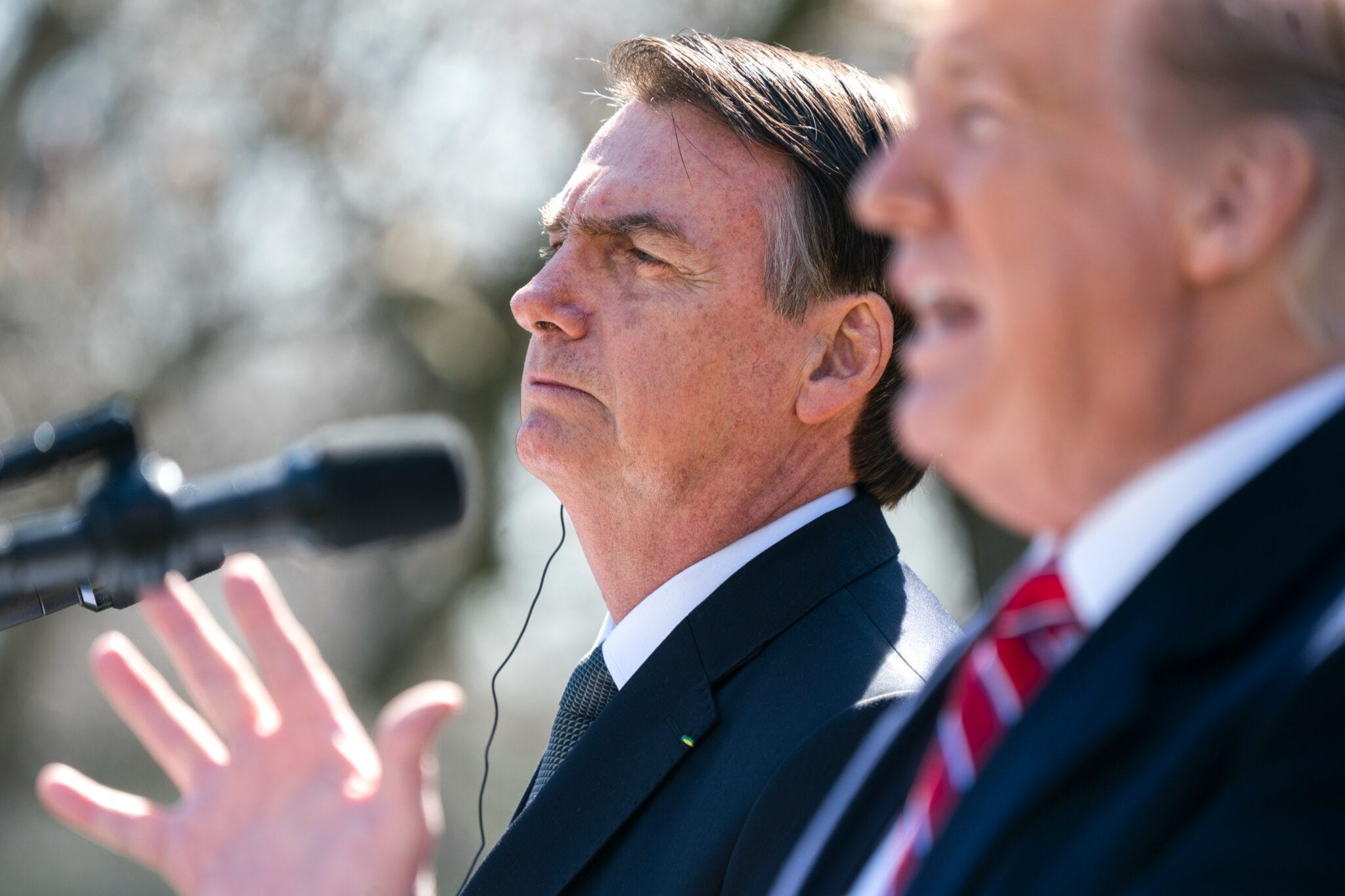
There are plenty of parallels between our situation and that of our neighbors to the south. Former President Jair Bolsonaro’s antipathy toward communists, open effort to amass personal wealth, and tendency to flaunt norms of “political correctness” in public speech helped earn him a description as “the Trump of the tropics.” More jarringly, the January 8, 2023, riots that stormed Brazil’s Supreme Court and Congress in a failed attempt to incite a military coup took place almost exactly two years after the January 6 attempt to prevent the transition of power in the White House. But what ought to inspire attention to the Brazilian case are not the similarities to events here but the differences. Most centrally, Bolsonaro has begun a twenty-seven-year prison sentence for his role in January 8, while the instigator of January 6 sits in the Oval Office.
Why did Brazil’s democratic institutions hold firm while those in the United States so quickly wilted? One explanation hinges on particular institutional actors. Perhaps Merrick Garland, the former U.S. attorney general, singularly altered the course of history by slow-walking the prosecution against Trump and other conspirators. Another takes a wider angle, alleging that President Biden and the wider Democratic Party’s reluctance to go on offense against the Republicans opened the door for Trump’s later return. On this view, the public memory of January 6 ought to have served not merely as proof of the antidemocratic aims of the right but as a point of orientation for both a legal and a propaganda battle around the legitimacy of the Republican Party and its standard-bearers. What must change, then, is not the discrete decisions of this or that institutional actor but the entire orientation of a political party from “folders” to “fighters.”
In a new book, Disputed Pasts: Forgetting and Remembering the Dictatorship in Brazil, political scientists Cristina Buarque de Hollanda and José Szwako test out this view in the Brazilian context. Bolsonaro’s conviction, they argue, owes much to the decades-long contest over how—or whether—to remember Brazil’s violent military dictatorship. As the authors point out, public memory not only bolstered the country’s “long return to democracy”; it also powered Bolsonaro’s attempt to halt it. In the United States, too, fights over narratives of the past—the right way, for example, to remember slavery and the genocide of indigenous people—have been waged by both the left and right. Should we in the United States try a Brazilian strategy?
→ Read the whole essay by Olúfẹ́mi O. Táíwò on BR’s website.